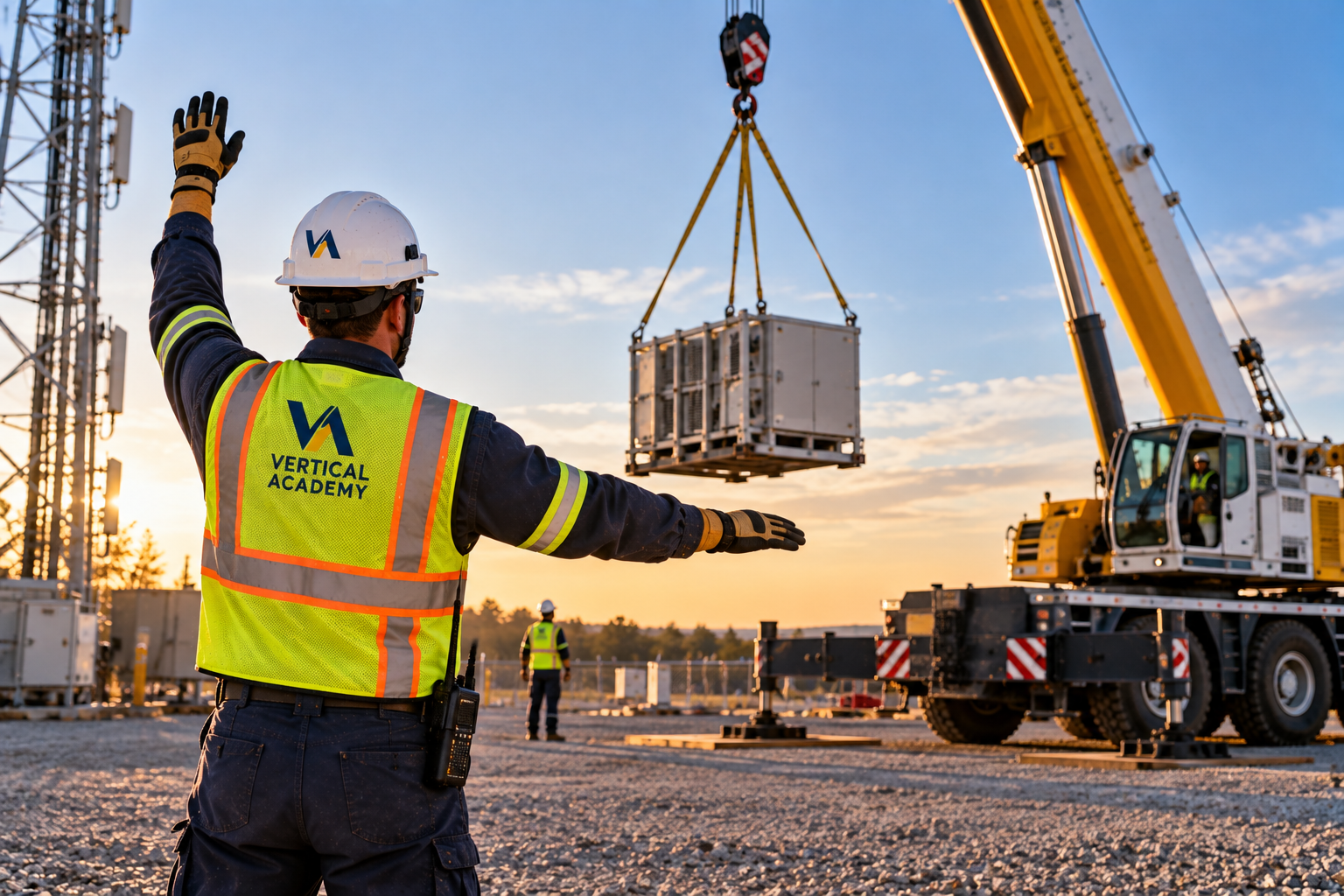
Online training that teaches signal persons and spotters the standard hand signals, clear voice and radio commands, safe positioning, and how to protect people from suspended loads and power lines.
By: Vertical Academy | Format: Online, self-paced | Language: English | Last Updated: 10/28/26
Description
This course is based on OSHA 29 CFR 1926 Subpart CC, Cranes and Derricks in Construction, including the signal requirements in 29 CFR 1926.1419 through 1926.1422, the standard hand signals in Appendix A, power-line safety in 29 CFR 1926.1408, suspended-load rules in 29 CFR 1926.1425, and signal person qualification in 29 CFR 1926.1428. It covers signaling methods, communication, crane movement basics, hazard recognition, and dedicated spotter duties, with telecom and blind-lift scenarios.
The course is intended for telecommunications, tower, construction, utility, and industrial workers who act as crane signal persons or spotters, and for the supervisors who plan lifts. It covers the knowledge portion of signal person qualification only. Under 29 CFR 1926.1428, a signal person must also pass a practical test, and the employer must have documentation from a third-party qualified evaluator or the employer’s own qualified evaluator before the person gives signals. An employer’s evaluation is not portable to other employers.
Learners who complete all lessons and pass the final exam receive a Vertical Academy completion certificate with a unique certificate number and QR code verification.
Topics covered
- Based on OSHA 29 CFR 1926 Subpart CC
- Introduction and Responsibilities (roles and boundaries; responsibilities and hazards)
- Crane Fundamentals for Signal Persons
- Standard Crane Hand Signals (hoist, lower, boom up and down, swing, stop, emergency stop, main and auxiliary hoist, extend and retract boom, travel, dog everything, combined signals, move slowly, equipment-specific signals, comparisons, and practice review)
- Radio and Voice Communication (clear commands and radio discipline; blind lifts and communication loss)
- Signal Person Positioning (safe positioning and escape routes)
- Signal Person and Spotter Responsibilities (equipment movement and backing; spotting structures and personnel)
- Power Line Safety and Dedicated Spotters
- Load and Work-Zone Hazards (suspended loads and load paths; tag lines, weather, and visibility)
- Stop Work and Emergency Signals (stop-work authority; emergency and conflicting signals)
- Real-World Scenarios (telecom and blind-lift scenarios)
- Final Review and Qualification Limits
- Lessons unlock in order; each lesson knowledge check must be passed at 100% before the next lesson opens
- Final exam: pass mark 80%, 3 attempts; after a third failed attempt, contact Vertical Academy
- Vertical Academy completion certificate with certificate number and QR verification
Standards & references
- OSHA 29 CFR 1926 Subpart CC: Cranes and derricks in construction
- OSHA 29 CFR 1926.1419 to 1926.1422: Signals (general requirements, radio/telephone/other electronic, voice, and hand signal charts)
- OSHA 29 CFR 1926 Subpart CC, Appendix A: Standard hand signals
- OSHA 29 CFR 1926.1408: Power line safety (up to 350 kV), equipment operations
- OSHA 29 CFR 1926.1425: Keeping clear of the load
- OSHA 29 CFR 1926.1428: Signal person qualifications
Contact us for more info
There are many options, including:
- Group discounts
- Training for your crews at your location
- Custom classes
- Much more
For more information, contact Vertical Academy at office@mozaksolution.com or +1 224 390 6979.
This is a Vertical Academy completion certificate for the knowledge portion of signal person training. It is not an OSHA certification and does not by itself qualify the holder as a signal person. A practical test and evaluator documentation under 29 CFR 1926.1428 are still required.