About Course
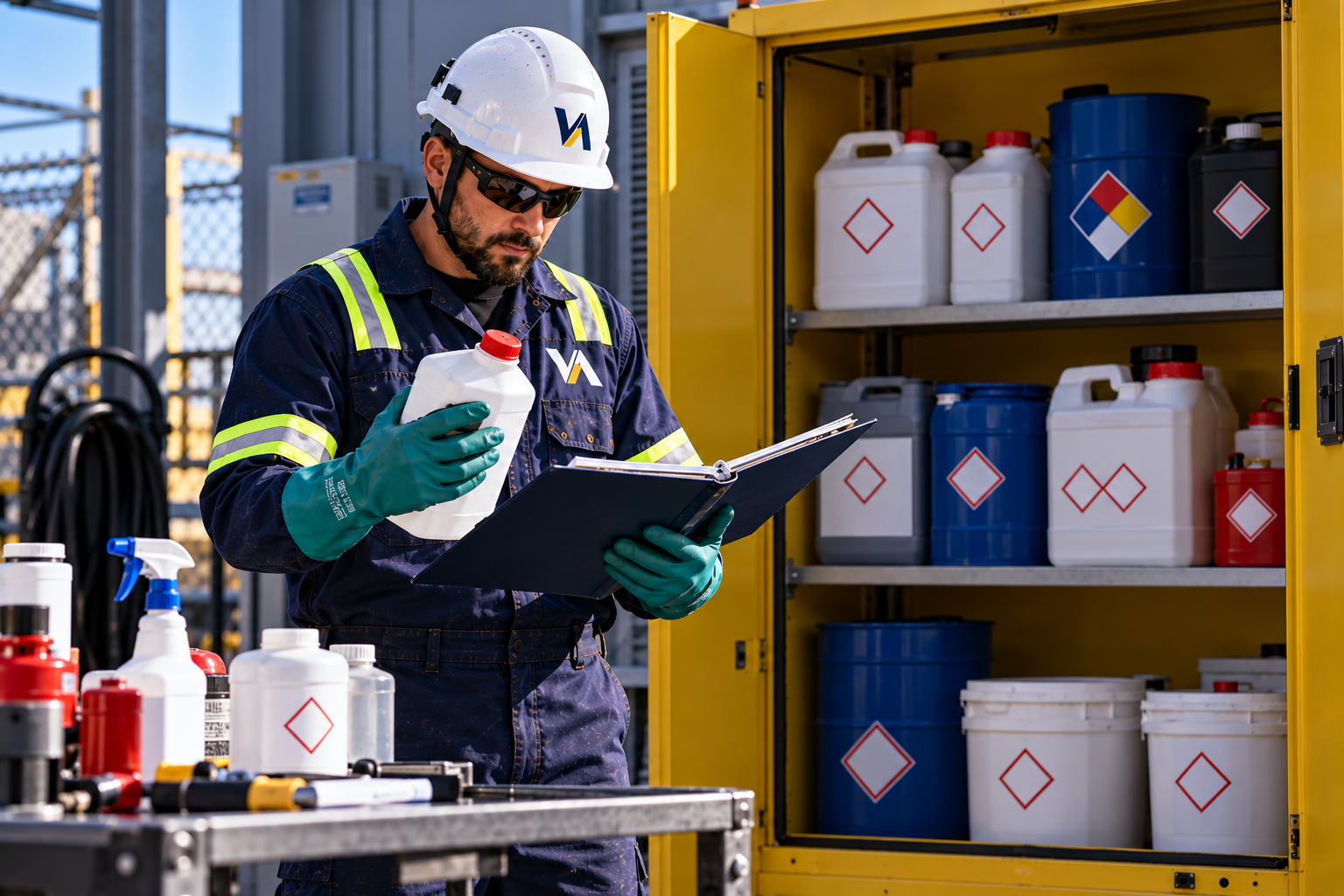
Online training that teaches workers how chemical hazards are classified and communicated through labels, pictograms, and Safety Data Sheets, and how to protect themselves when working with hazardous chemicals.
By: Vertical Academy | Format: Online, self-paced | Certification validity: 2 years | Language: English
Description
This course is based on OSHA 29 CFR 1910.1200, the Hazard Communication Standard (HCS), which is aligned with the Globally Harmonized System of Classification and Labelling of Chemicals (GHS). It covers the employee information and training requirements in 1910.1200(h), hazard classification (Appendices A and B), label elements and pictograms (Appendix C), and Safety Data Sheets (Appendix D).
The course is intended for telecommunications, construction, and field workers who use or may be exposed to hazardous chemicals, and for their supervisors. It does not replace your employer’s written hazard communication program or training on the specific chemicals in your work area.
Learners who complete all lessons and pass the final exam receive a Vertical Academy completion certificate with a unique certificate number and QR code verification.
Topics covered
- About 1 hour 30 minutes of online, self-paced training
- Based on OSHA 29 CFR 1910.1200
- Module 1: Introduction to Hazard Communication (purpose and scope of the HCS; employer and employee responsibilities; the written program)
- Module 2: Chemical Hazards and Exposure Routes (physical and health hazards; inhalation, skin and eye contact, ingestion, and injection)
- Module 3: GHS Classification and Pictograms (hazard classes and categories; the nine pictograms)
- Module 4: Chemical Labels and Warnings (required label elements; signal words “Danger” and “Warning”; workplace labeling)
- Module 5: Safety Data Sheets (SDS) (the 16-section format; finding hazards, protective measures, and first aid; access to SDSs)
- Module 6: Exposure Prevention and PPE (controls and protective measures listed on the SDS)
- Module 7: Safe Handling and Chemical Storage
- Module 8: Telecom and Construction Hazards
- Module 9: Emergency Procedures and Employee Rights (spill and exposure response; the right to information and training)
- Module 10: Course Review and Practical Scenarios
- Lessons unlock in order; each lesson knowledge check must be passed at 100% before the next lesson opens
- Final exam: 30 questions, pass mark 80%, 3 attempts; after a third failed attempt, contact Vertical Academy
- Vertical Academy completion certificate with certificate number and QR verification
Standards & references
- OSHA 29 CFR 1910.1200: Hazard communication
- 29 CFR 1910.1200(h): Employee information and training
- 29 CFR 1910.1200 Appendix B: Physical hazard criteria
- 29 CFR 1910.1200 Appendix C: Allocation of label elements (pictograms, signal words, statements)
- 29 CFR 1910.1200 Appendix D: Safety Data Sheets
- OSHA 29 CFR 1926.59: Hazard communication (construction)
- United Nations Globally Harmonized System of Classification and Labelling of Chemicals (GHS), Revision 7, as referenced by the HCS
Curriculum
- Module 1: Introduction to Hazard Communication (6 min) – Welcome from Vertical Academy; purpose of HazCom and the right to know; 1910.1200 and 1926.59; the 2024 update; the written program; employer and employee responsibilities; when training is required.
- Module 2: Chemical Hazards and Exposure Routes (9 min) – Physical hazards; health hazards (acute and chronic); routes of exposure; recognizing hazards and releases (odor alone is unreliable).
- Module 3: GHS Classification and Pictograms (10 min) – GHS overview; hazard classes and categories; signal words “Danger” and “Warning”; the pictograms; precedence rules; pictogram-matching activity.
- Module 4: Chemical Labels and Warnings (9 min) – Six required label elements for shipped containers; small-container labeling; workplace labeling of secondary and stationary containers; portable-container exception; missing or damaged labels; realistic label exercise.
- Module 5: Safety Data Sheets (SDS) (12 min) – Purpose of the SDS; access during each work shift; the 16-section format (Sections 12–15 not enforced by OSHA); trade-secret limits; using an SDS exercise.
- Module 6: Exposure Prevention and PPE (8 min) – Hierarchy of controls; PPE for chemical hazards (gloves, eye and face, protective clothing, compatibility); respiratory protection only under the employer’s 1910.134 program.
- Module 7: Safe Handling and Chemical Storage (7 min) – Safe handling; ventilation; never mixing chemicals without authorization; incompatible materials; flammable liquids; compressed gas cylinders; reporting unsafe conditions.
- Module 8: Telecom and Construction Chemical Hazards (7 min) – Generator fuels, battery electrolytes, solvents, adhesives and sealants, paints, aerosols, compressed gases; contractor responsibilities on multi-employer worksites.
- Module 9: Emergency Procedures and Employee Rights (6 min) – Recognizing a release; reporting and evacuation; SDS first-aid information; awareness-level actions vs HAZMAT response; employee rights and responsibilities.
- Module 10: Course Review and Practical Scenarios (4 min) – Key principles; five practical scenarios; reminder of employer-specific training.
- Final exam (12 min) – 30 multiple-choice questions drawn from the question bank; pass mark 80%; maximum 3 attempts.
Contact us for more info
There are many options, including:
- Group discounts
- Training for your crews at your location
- Custom classes
- Much more
Contact Vertical Academy for details: phone 224 390 69 79 | email training@verticalacademy.us
This is a Vertical Academy completion certificate. It is not an OSHA certification; OSHA does not approve or certify training courses of this kind. Employers must also train workers on the specific hazardous chemicals in their work area.