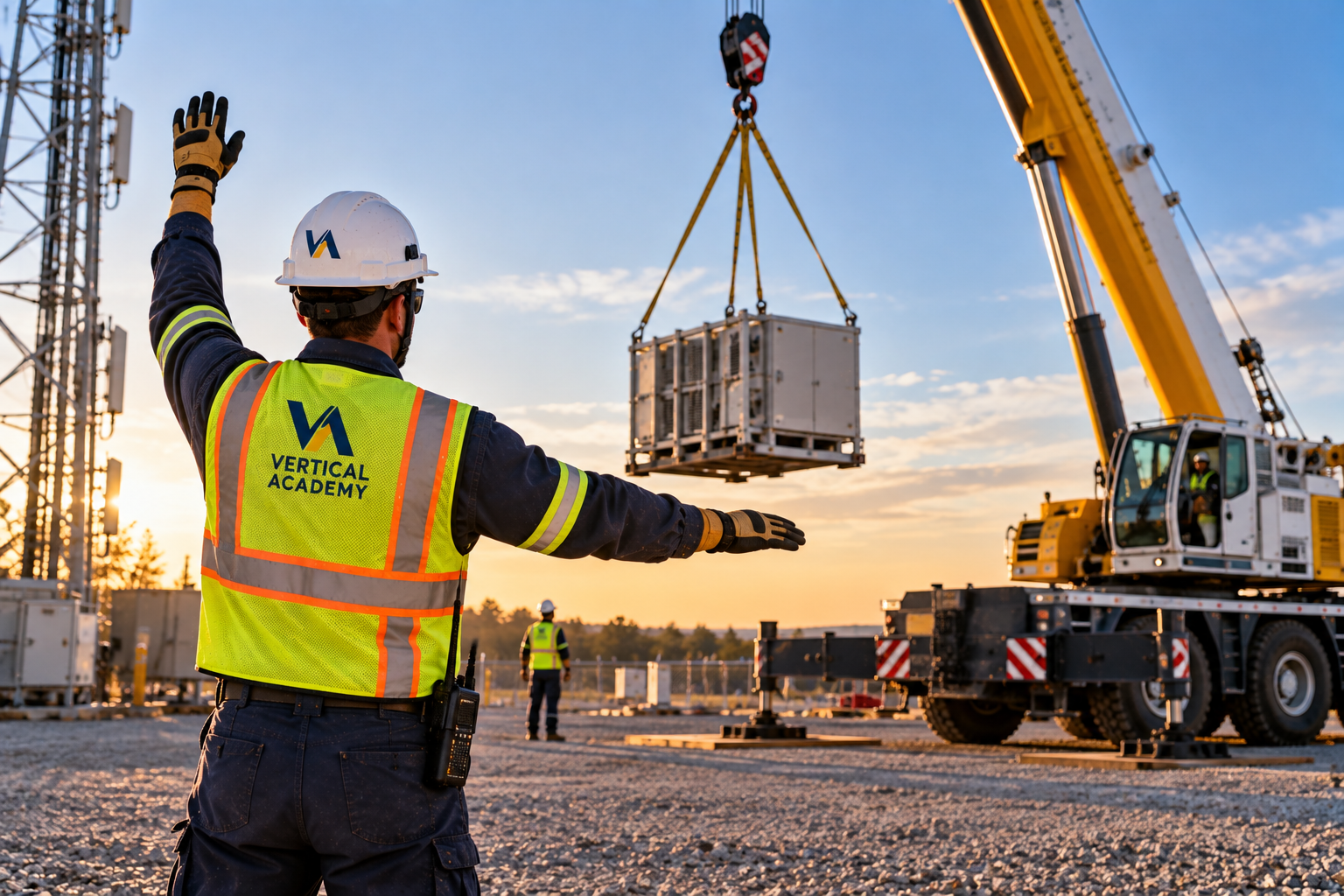
Online training that teaches signal persons and spotters the standard hand signals, clear voice and radio commands, safe positioning, and how to protect people from suspended loads and power lines.
By: Vertical Academy | Format: Online, self-paced | Certification validity: 2 years | Language: English
Description
This course is based on OSHA 29 CFR 1926 Subpart CC, Cranes and Derricks in Construction, including the signal requirements in 29 CFR 1926.1419 through 1926.1422, the standard hand signals in Appendix A, power-line safety in 29 CFR 1926.1408, suspended-load rules in 29 CFR 1926.1425, and signal person qualification in 29 CFR 1926.1428. It covers signaling methods, communication, crane movement basics, hazard recognition, and dedicated spotter duties, with telecom and blind-lift scenarios.
The course is intended for telecommunications, tower, construction, utility, and industrial workers who act as crane signal persons or spotters, and for the supervisors who plan lifts. It covers the knowledge portion of signal person qualification only. Under 29 CFR 1926.1428, a signal person must also pass a practical test, and the employer must have documentation from a third-party qualified evaluator or the employer’s own qualified evaluator before the person gives signals. An employer’s evaluation is not portable to other employers.
Learners who complete all lessons and pass the final exam receive a Vertical Academy completion certificate with a unique certificate number and QR code verification.
Topics covered
- About 1 hour 30 minutes of online, self-paced training
- Based on OSHA 29 CFR 1926 Subpart CC
- Module 1: Introduction and Responsibilities (roles and boundaries; responsibilities and hazards)
- Module 2: Crane Fundamentals for Signal Persons
- Module 3: Standard Crane Hand Signals (hoist, lower, boom up and down, swing, stop, emergency stop, main and auxiliary hoist, extend and retract boom, travel, dog everything, combined signals, move slowly, equipment-specific signals, comparisons, and practice review)
- Module 4: Radio and Voice Communication (clear commands and radio discipline; blind lifts and communication loss)
- Module 5: Signal Person Positioning (safe positioning and escape routes)
- Module 6: Signal Person and Spotter Responsibilities (equipment movement and backing; spotting structures and personnel)
- Module 7: Power Line Safety and Dedicated Spotters
- Module 8: Load and Work-Zone Hazards (suspended loads and load paths; tag lines, weather, and visibility)
- Module 9: Stop Work and Emergency Signals (stop-work authority; emergency and conflicting signals)
- Module 10: Real-World Scenarios (telecom and blind-lift scenarios)
- Module 11: Final Review and Qualification Limits
- Lessons unlock in order; each lesson knowledge check must be passed at 100% before the next lesson opens
- Final exam: 30 questions, pass mark 80%, 3 attempts; after a third failed attempt, contact Vertical Academy
- Vertical Academy completion certificate with certificate number and QR verification
Standards & references
- OSHA 29 CFR 1926 Subpart CC: Cranes and derricks in construction
- OSHA 29 CFR 1926.1419 to 1926.1422: Signals (general requirements, radio/telephone/other electronic, voice, and hand signal charts)
- OSHA 29 CFR 1926 Subpart CC, Appendix A: Standard hand signals
- OSHA 29 CFR 1926.1408: Power line safety (up to 350 kV), equipment operations
- OSHA 29 CFR 1926.1425: Keeping clear of the load
- OSHA 29 CFR 1926.1428: Signal person qualifications
Curriculum
- Module 1: Introduction and Responsibilities (11 min) – Welcome and course scope; roles and boundaries; responsibilities and hazards.
- Module 2: Crane Fundamentals for Signal Persons (6 min) – Crane types and components; boom, hoist and swing functions; load charts (awareness); stopping and swing dynamics.
- Module 3: Standard Crane Hand Signals (15 min) – Hoist, lower, boom up and down, swing, stop, emergency stop, main and auxiliary (whipline) hoist, extend and retract boom, travel, dog everything, combined boom and load signals, move slowly, equipment-specific signals; comparisons and practice review.
- Module 4: Radio and Voice Communication (8 min) – Clear commands and radio discipline; dedicated channel; hands-free reception by the operator; voice signal sequence; blind lifts and communication loss.
- Module 5: Signal Person Positioning (4 min) – Safe positioning, line of sight with the operator and the load, escape routes.
- Module 6: Signal Person and Spotter Responsibilities (6 min) – Equipment movement and backing; spotting structures and personnel.
- Module 7: Power Line Safety and Dedicated Spotters (8 min) – Power-line safety options for lines up to 350 kV; 20-foot work zone and Table A clearances; dedicated spotter duties and qualification; electrical contact emergency awareness.
- Module 8: Load and Work-Zone Hazards (7 min) – Suspended loads and load paths; fall zone; tag lines, weather and visibility.
- Module 9: Stop Work and Emergency Signals (4 min) – Stop-work authority; emergency stop from anyone; emergency and conflicting signals.
- Module 10: Real-World Scenarios (6 min) – Telecom and blind-lift scenarios; integrated scenario knowledge check.
- Module 11: Final Review and Qualification Limits (3 min) – Key points; what a completion certificate does and does not mean; practical test and documentation under 1926.1428.
- Final exam (12 min) – 30 multiple-choice questions; pass mark 80%; maximum 3 attempts.
Contact us for more info
There are many options, including:
- Group discounts
- Training for your crews at your location
- Custom classes
- Much more
Contact Vertical Academy for details: phone 224 390 69 79 | email training@verticalacademy.us
This is a Vertical Academy completion certificate for the knowledge portion of signal person training. It is not an OSHA certification and does not by itself qualify the holder as a signal person. A practical test and evaluator documentation under 29 CFR 1926.1428 are still required.