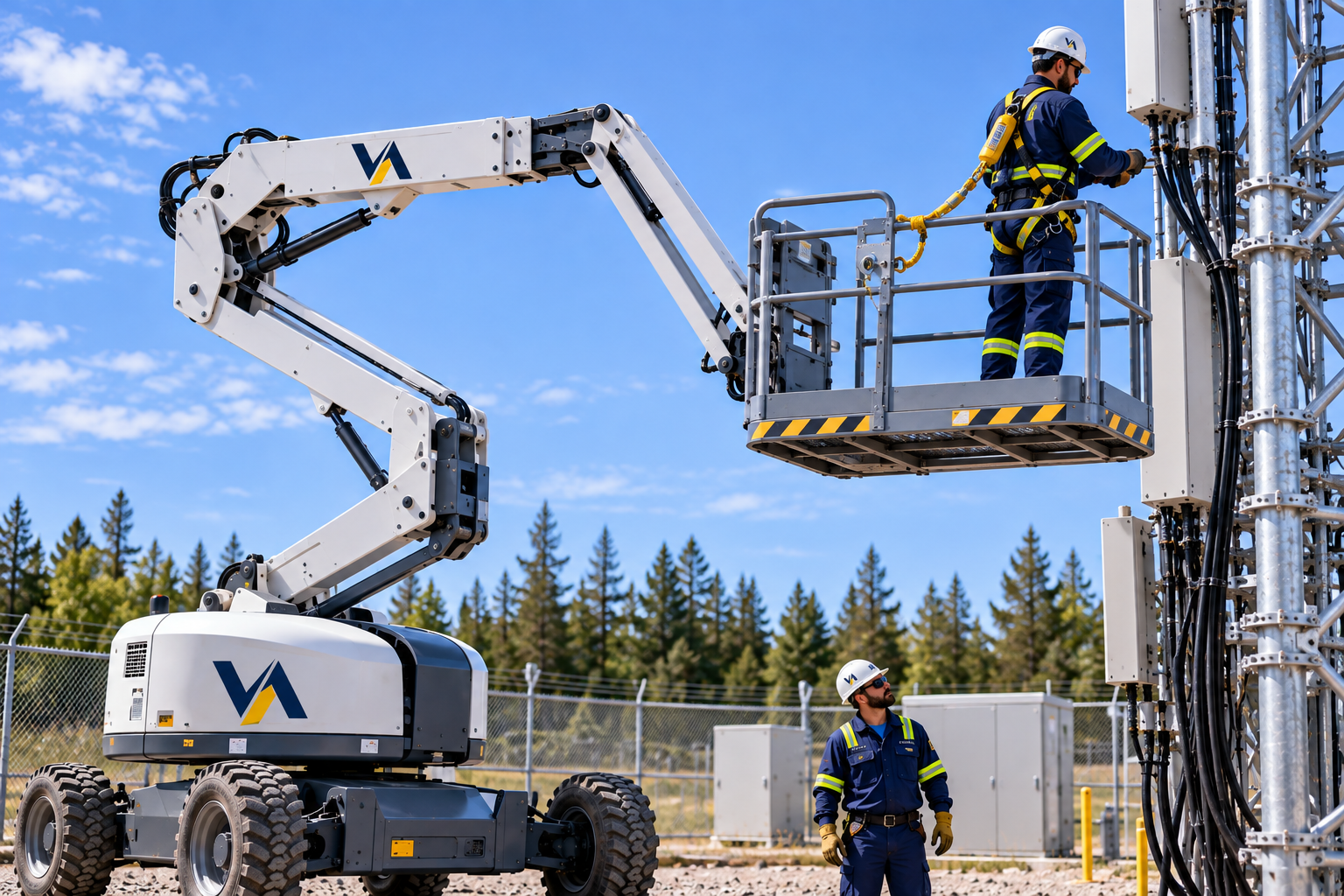
Online theory training that teaches operators and occupants of scissor lifts, vertical mast lifts, and boom lifts to recognize MEWP hazards, inspect the machine and work area, and operate and respond to emergencies safely.
By: Vertical Academy | Format: Online, self-paced | Language: English | Last Updated: 10/28/26
Description
This course is based on OSHA requirements for aerial lifts, including 29 CFR 1926.453 (construction) and 29 CFR 1910.67 (general industry), and on the terminology and principles of the ANSI/SAIA A92 MEWP standards, including A92.22 (safe use) and A92.24 (training). It also stresses manufacturer instructions and accepted safe-work practices. It covers MEWP types and classification, hazards, inspection, fall protection, safe operation, electrical hazard awareness, stability, entrapment, and emergency procedures.
The course is intended for telecommunications, construction, maintenance, and industrial workers who operate or work from MEWPs, and for the supervisors who direct them. This is theory training only. Completing this online course does not authorize anyone to operate a MEWP. Before authorizing an operator, the employer must still provide hands-on practical training, machine-specific familiarization, and a practical operator evaluation on the model to be used.
Learners who complete all lessons and pass the final exam receive a Vertical Academy theory completion certificate with a unique certificate number and QR code verification.
Topics covered
- Based on OSHA 29 CFR 1926.453 and 29 CFR 1910.67, and aligned with ANSI/SAIA A92 terminology and principles
- MEWP Safety Foundations (purpose and objectives; responsibilities and authorization)
- MEWP Types and Classification (scissor, vertical mast, articulating boom, and telescopic boom lifts; group and type classification)
- Major MEWP Hazards (falls; tip-over and stability; electrocution and crushing; collisions, falling objects, weather, and wind)
- Pre-Use Equipment Inspection (visual, structural, rails and gates, controls and safety devices, hydraulic, electrical, fuel, and documentation)
- Workplace and Work Area Inspection (ground conditions; overhead and electrical hazards; traffic, pedestrians, weather, and wind)
- Fall Protection (guardrail protection; personal fall protection; boom anchors and prohibited practices)
- Safe MEWP Operation (entry, exit, capacity, and loads; travel, positioning, and visibility; shutdown and securing)
- Electrical Hazard Awareness (power-line planning; electrical contact response)
- Stability and Tip-Over Prevention; Crushing and Entrapment
- Emergency Procedures (emergency stop and ground controls; lowering, incapacitation, and rescue)
- Practical Operator Evaluation overview: the criteria your employer’s evaluator will look for (the evaluation itself is done in person, not online)
- Lessons unlock in order; each lesson knowledge check must be passed at 100% before the next lesson opens
- Final exam: 30 questions, pass mark 80%, 3 attempts; after a third failed attempt, contact Vertical Academy
- Vertical Academy MEWP theory completion certificate with certificate number and QR verification
Standards & references
- OSHA 29 CFR 1926.453: Aerial lifts (construction)
- OSHA 29 CFR 1910.67: Vehicle-mounted elevating and rotating work platforms (general industry)
- ANSI/SAIA A92.22: Safe use of mobile elevating work platforms (MEWPs)
- ANSI/SAIA A92.24: Training requirements for the use, operation, inspection, testing, and maintenance of MEWPs
- Manufacturer’s operating manual for the specific MEWP model
Contact us for more info
There are many options, including:
- Group discounts
- Training for your crews at your location
- Custom classes
- Much more
For more information, contact Vertical Academy at office@mozaksolution.com or +1 224 390 6979.
This is a Vertical Academy theory completion certificate. It is not an OSHA or ANSI certification and does not authorize the holder to operate a MEWP. The employer must provide practical training, familiarization, and an operator evaluation before authorization.