About Course
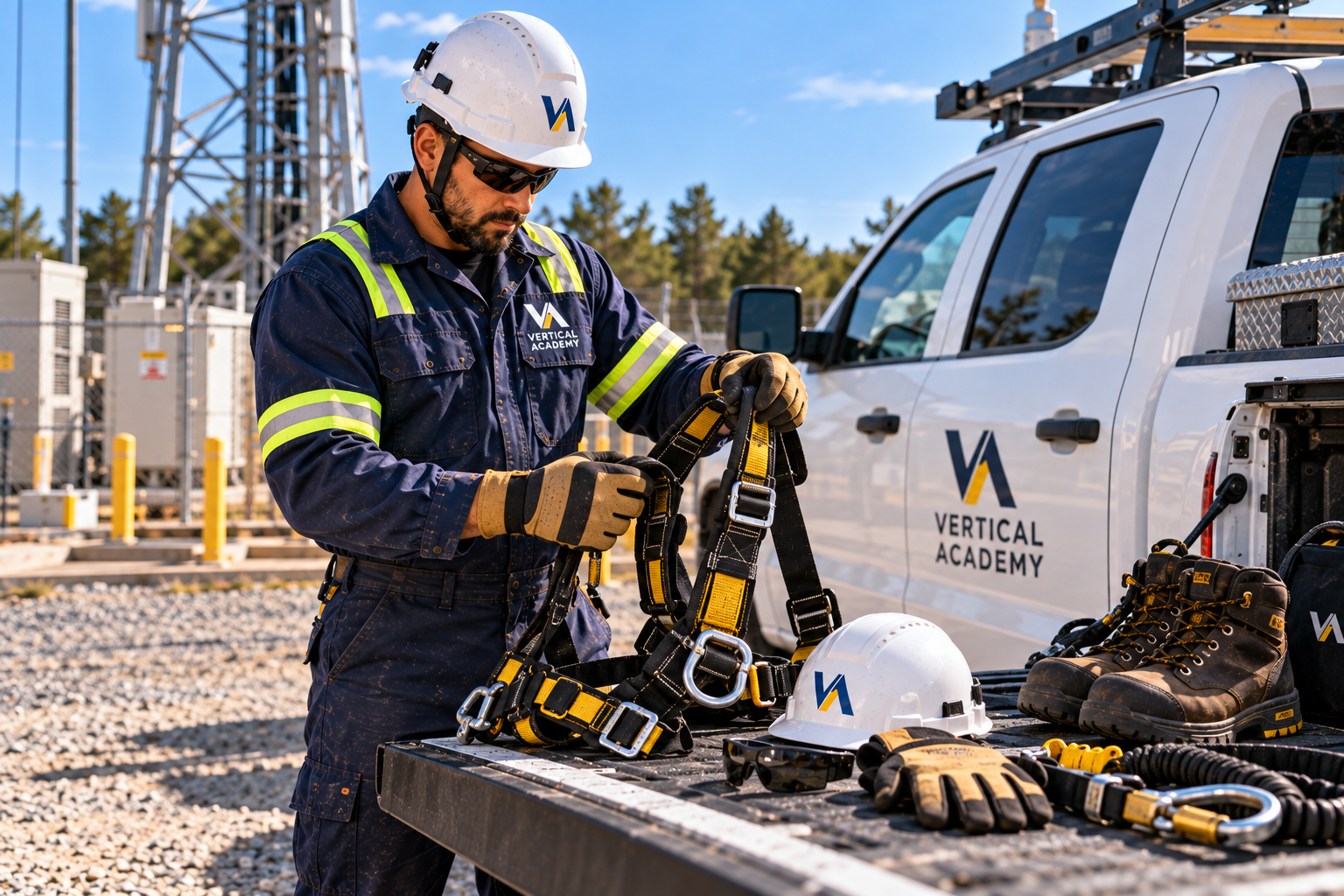
Online training that teaches field workers how to assess jobsite hazards, select and fit the right PPE, inspect and care for it, and know its limits.
By: Vertical Academy | Format: Online, self-paced | Language: English | Last Updated: 10/28/26
Description
This course is based on OSHA’s personal protective equipment requirements, including 29 CFR 1910.132 (general industry) and 29 CFR 1926.95 (construction), which require employers to assess hazards, provide suitable PPE, and train workers in its use, limits, care, and replacement. It also follows manufacturer instructions and uses realistic jobsite scenarios.
The course is intended for telecommunications, tower, construction, rigging, ground, and field workers and their supervisors. It is awareness and knowledge training. It does not replace your employer’s hazard assessment, task-specific PPE training, or respiratory protection program, and it is not respirator fit testing. Fall protection equipment is covered in Vertical Academy’s work-at-height courses.
Learners who complete all lessons and pass the final exam receive a Vertical Academy completion certificate with a unique certificate number and QR code verification.
Topics covered
- Based on OSHA 29 CFR 1910.132 and 29 CFR 1926.95
- Module 1: PPE Fundamentals (what PPE is; the hierarchy of controls; responsibilities, training, and PPE limits)
- Module 2: Hazard Assessment and PPE Selection (assessing the worksite; hazard-based selection, fit, compatibility, and defective PPE)
- Module 3: Head Protection (hard hats and safety helmets; fit, inspection, damage, and replacement)
- Module 4: Eye and Face Protection (hazards; safety glasses, goggles, and face shields; inspection, care, and radiant energy awareness)
- Module 5: Hearing Protection (noise hazards; earplugs, earmuffs, and NRR; fit, double protection, and hearing conservation)
- Module 6: Respiratory Protection Awareness (hazards and exposure types; respirator types; inspection, cleaning, and storage; program, medical evaluation, and fit testing)
- Module 7: Hand, Arm, Body, and Foot Protection (gloves and chemical or electrical awareness; body and high-visibility protection; foot protection)
- Module 8: PPE Inspection, Care, and Worker Responsibilities (pre-use inspection; cleaning and storage; removing and reporting defective PPE; integrated jobsite scenario)
- Lessons unlock in order; each lesson knowledge check must be passed at 100% before the next lesson opens
- Final exam: 30 questions, pass mark 80%, 3 attempts; after a third failed attempt, contact Vertical Academy
- Vertical Academy completion certificate with certificate number and QR verification
Standards & references
- OSHA 29 CFR 1910.132 and 1926.95: Personal protective equipment, general requirements
- OSHA 29 CFR 1910.133 and 1926.102: Eye and face protection
- OSHA 29 CFR 1910.135 and 1926.100: Head protection
- OSHA 29 CFR 1910.95 and 1926.101: Occupational noise exposure and hearing protection
- OSHA 29 CFR 1910.134: Respiratory protection
- OSHA 29 CFR 1910.136 and 1910.138: Foot protection and hand protection
Contact us for more info
There are many options, including:
- Group discounts
- Training for your crews at your location
- Custom classes
- Much more
For more information, contact Vertical Academy at office@mozaksolution.com or +1 224 390 6979.
This is a Vertical Academy completion certificate. It is not an OSHA or ANSI certification and is not a respirator fit test or medical clearance.